


- Rooting in Greek

Representation of Ptolemy Date: 1584 Source: Les vrais pourtraits et vies des hommes illustres grecz, latins, et payens recueilliz de leurs tableaux livres et medalles antiques, et modernes. Par Andre Thevet angoumoysin, premier cosmographe du roy., premier tome, livre II, chap. 41, "Claude Ptolemee Pelusien", p. 87. Published by Blanche Marantin and Guillaume Chaudiere, Paris, Copyright: Wikimedia Commons
The cosmological basis of the astrolabe is the two-sphere universe, and its mathematical basis is the stereographic projection, both of them originated in ancient Greece. Although there are legends attributing the inventing of astrolabe to Ptolemy of Alexandria, there is no evidence that he ever made or used an astrolabe. Despite this, he was undoubtedly proficient in stereographic projection, and his work, Planisphaerium (On Flattened Sphere), survived until now.
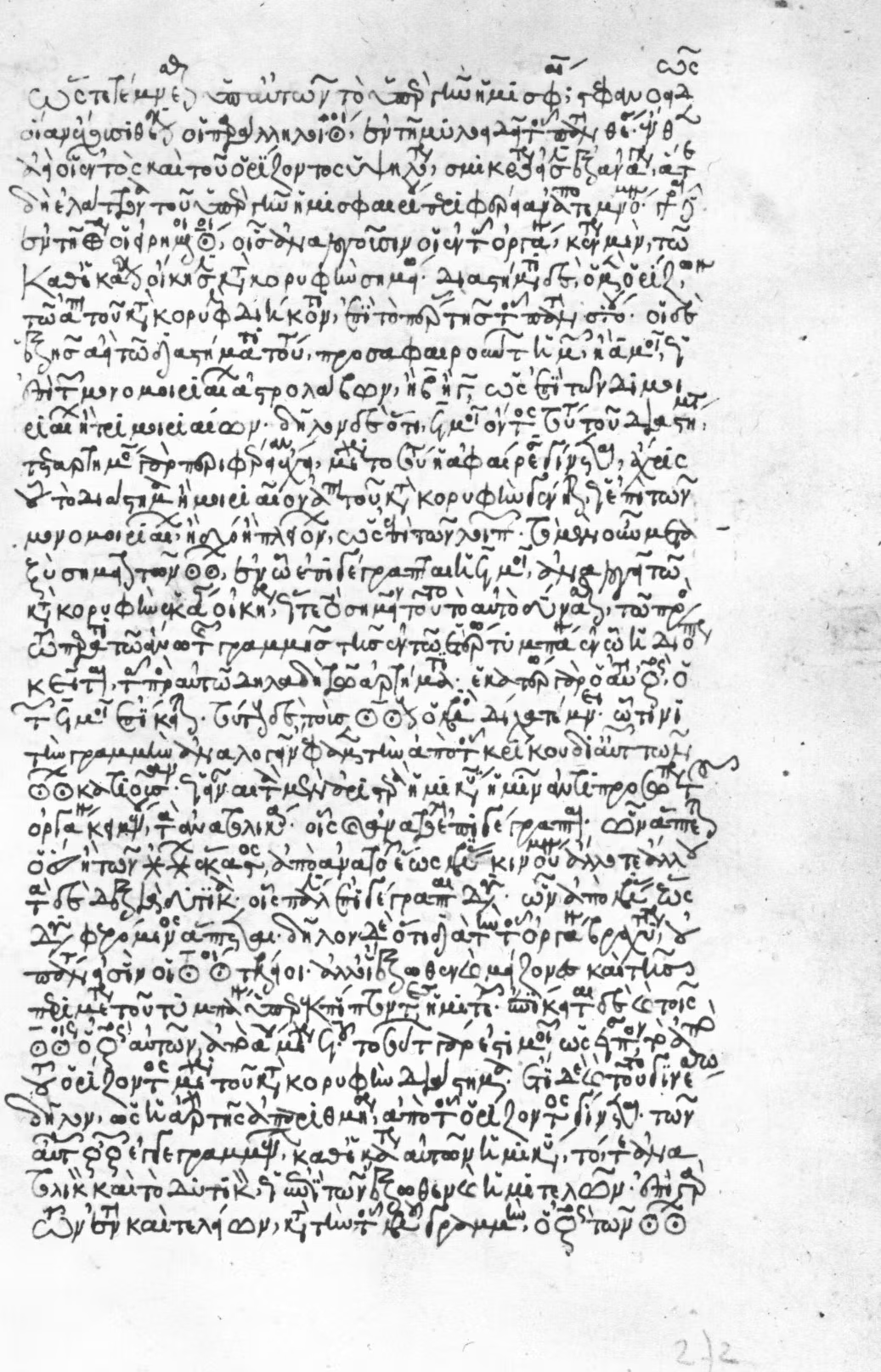
Greek manuscript of John Philoponus’ De usu astrolabii eiusque constructione, Date:1831/1832 Source: Florence, Biblioteca Medicea Laurenziana, ms. Plut. 28,16, fol. 272r. Copyright: Wikimedia Commons
The Hellenistic astronomer Theon of Alexandria (active in 364) wrote the earliest known work on astrolabes, but they are lost. Later, John Philoponus (c. 490~c. 570) wrote De usu astrolabii eiusque constructione (On the Use and Construction of the Astrolabe), which is the earliest surviving work on astrolabes.
- Flourishing in Arabia
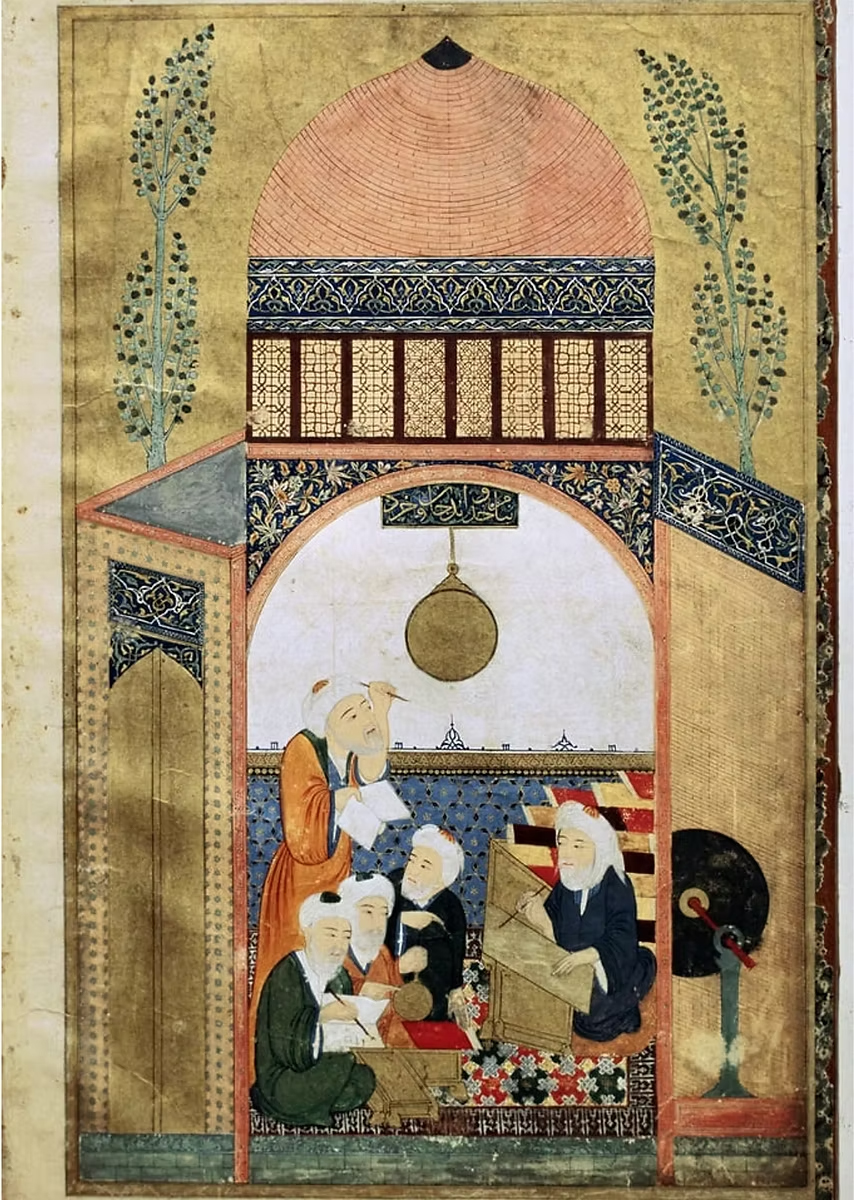
A Lecture on astronomy, four scientists with their master (or Nasir al-Din al-Tusi's observatory in Maragha) Date: c. 1418 Source: Kitab Ramda al Munajimin, Persian manuscript Copyright:University Library, Istanbul, Turkey
The astrolabe first became popular in the Islamic world. At that time, the Arab Empire was new, and everything was waiting to be done. So the Arabs translated the academic classics of ancient Greece, Rome, Persia, India and other countries into Arabic, absorbing advanced cultural heritage. Translation activities began in the Umayyad Dynasty, and then the Abbasid Caliphate provided encouragement and funding, pushing the translation movement to a climax. At its peak, the movement lasted nearly a hundred years (830-930) and was known as the Harakah al-Tarjamah (The Graeco-Arabic Translation Movement). Many of the fruits of the Greek language were introduced to Arabia, including the Astrolabe.
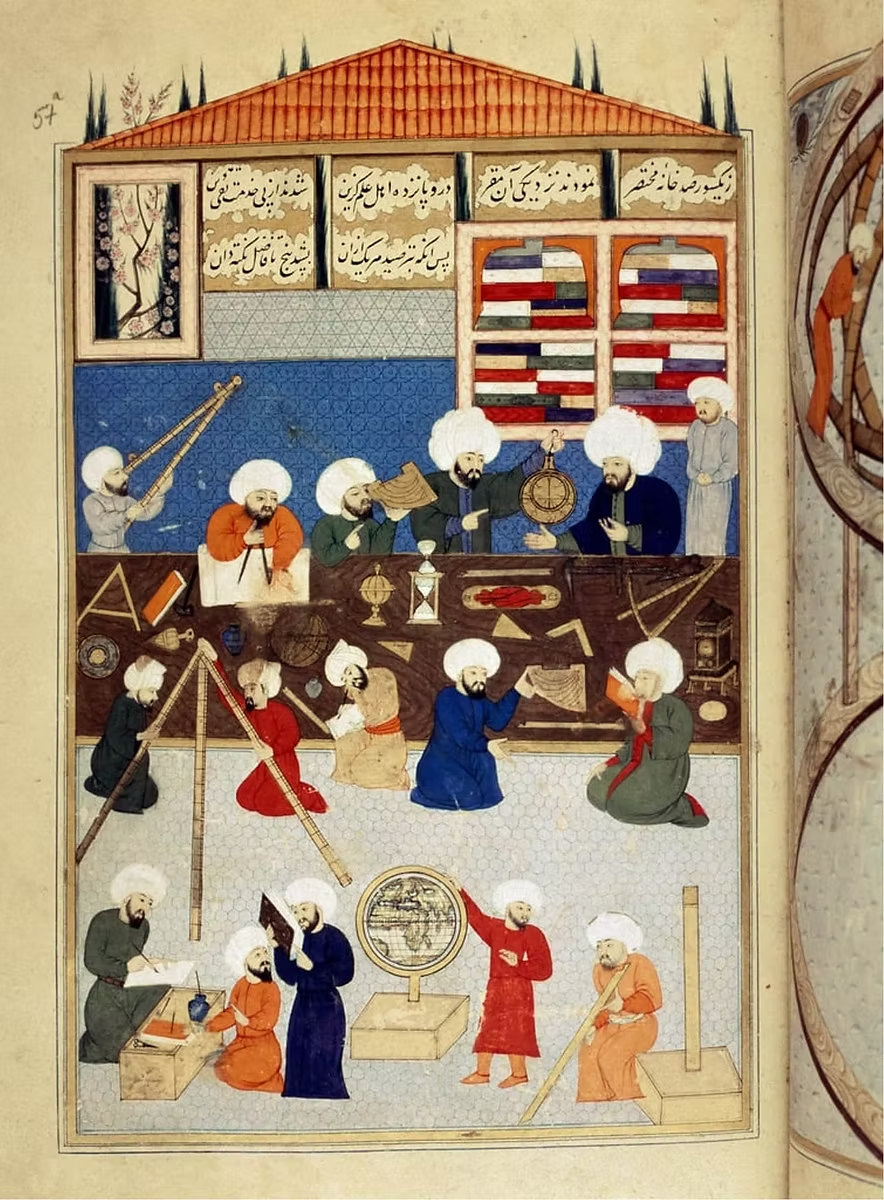
Ottoman astronomers at work around Taqī al-Dīn at the Istanbul Observatory Date: between circa 1574 and circa 1595 Source: Ṣehinṣename (Book of the King of Kings), Istanbul University Library, F 1404, fol. 57a Author: Ala ad-Din Mansur-Shirazi Copyright: Wikimedia Commons
The astrolabe is particularly important to Muslims because Muslims need to determine the time and direction every time they pray, and this is what astrolabe does. In addition, the Arabian Peninsula is mostly plain and arid with little rain, making it conducive to observation at night. All these have contributed to the prosperity of instrument production and related research, and also led to the invention of many variations of the astrolabe.
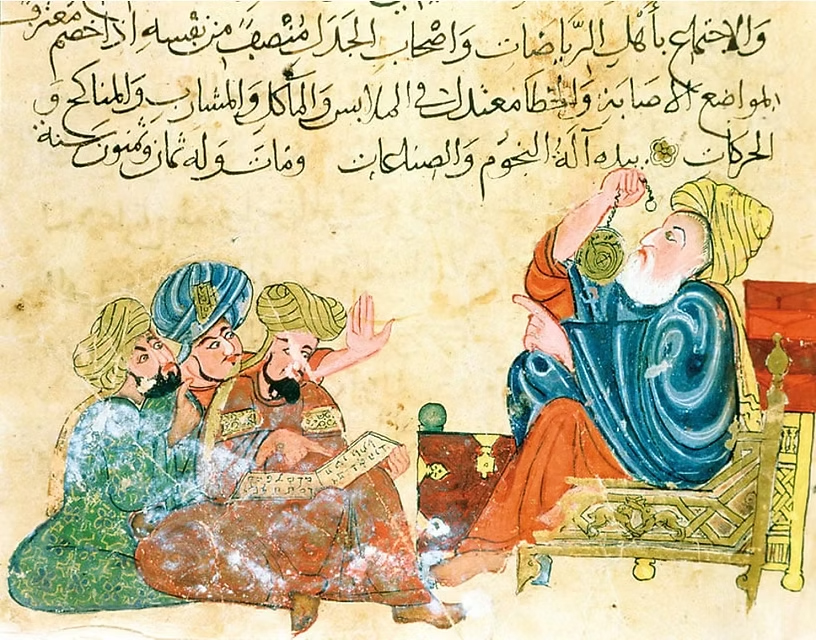
Aristotle teaching astronomy with an astrolabe Date: 13th century Source: Kitab Mukhtar al-Hikam wa-Mahasin al-Kilam (pen & ink and gouache on paper), Turkish School’s MS Ahmed III 3206 Author: al-Mubashir Copyright: Topkapi Palace Museum, Istanbul, Turkey.
The picture to the right is an interesting anachronism: Aristotle was teaching astronomy with an astrolabe. At that time, Muslims already knew Aristotle and respected him as “First Teacher/Philosopher” (al-mu ʿallim al-awwal),regarding him as the representative of Greek philosophers and the embodiment of knowledge. He is therefore pictured using an astrolabe, although we know that Aristotle in history never used this instrument.
- Popularizing in Europe

Three scientists using an astrolabe Date: 13th century Source: Psautier de Saint Louis et de Blanche de Castille, Bibliothèque Nationale de France.
The emergence of the astrolabe in Europe was also due to a translation movement. Beginning in 1000 AD, Western Europeans crossed the Pyrenees Mountains to obtain texts from Spain, which was ruled by Muslims. Some people also obtained Greek texts directly from the Eastern Roman Empire. This translation movement was most concentrated in the 12th century, and the works were finally translated into Latin, so it was called the "Latin translation movement of the 12th century."

Popularizing in Europe Date: circa 1400 Source: Mandeville’s Travels, BL Add. Ms 24189 f15r Copyright: Wikimedia Commons
Astrolabes also came to Western Europe with translations and became an important part of medieval astronomy. People in the Middle Ages used it to identify the stars, determine time and location, and predict bad luck. The astrolabe made of brass is exquisite, but expensive. After the advent of paper and printing, paper astrolabes were mass-produced and often used in teaching activities.

Geoffrey Chaucer teaching his young son Lewis to use the astrolabe Date: 1896 Source: The Works of Geoffrey Chaucer, London: Kelmscott Press Author: William Morris, 1834–1896, designer, Edward Burne-Jones, 1838–1898, illustrator
Astrolabes became widespread during the Middle Ages. As a symbol of knowledge, they were used by people who are not experts in astronomy. Geoffrey Chaucer, a medieval British poet who was later regarded as the "Father of English Literature", also wrote A Treatise on the Astrolabe. he stated that he wrote this book for his son Lewis to further study astronomy. The picture on the right is a later depiction of him teaching his young son Lewis how to use an astrolabe.

Portrait of Regiomontanus Date: 1493 Source: scrapted from Nuremberg chronicles, f255r Copyright: World Digital Library Collection
The 15th and 16th centuries were the peak of scientific astrolabe manufacturing in Europe, and outstanding craftsmen and workshops emerged in various places. Excellent writings and fine instruments were popular. Astrolabes also appear frequently in paintings, becoming a symbol for astronomers and even science.

One illustrated page of Elucidatio fabricae vsusque astrolabii Date: 1524 Source: Elucidatio fabricae vsusque astrolabii Copyright: History of Science Museum, Oxford
According to the Oxford Museum of the History of Science, it was “one of the most influential books on a scientific instrument ever to be published. . . . Many authors of the many books on mathematical instruments to be published in the 16th century followed Stöffler’s example.”

Records about “Instruments of the Western Regions” in Yuan History Date: 1778 Source: “The Imperial Siku Quanshu Selected Collection: Volume 6427, History Part, Yuan History, Volume 48, Astronomical History No.1, Astronomy No.1", photocopied by Taiwan World Book Company, 1985
Spreading to China
Astrolabe was introduced to China twice in history. According to the Records of Tianwenzhi (History of Astronomy) in Yuan Shi (History of Yuan Dynasty): "In the fourth year of Zhiyuan Period under the reign of Emperor Shizu (CE1267), Zhamaluding built instruments of the Western Regions." Zhamaluding (Jamal ad-Din Bukhari) was a 13th-century Persian astronomer originally from Bukhara. He brought seven instruments, including an armillary sphere, a globe, etc. The seventh one, "Wu Su Du Er La Bu", was the astrolabe.
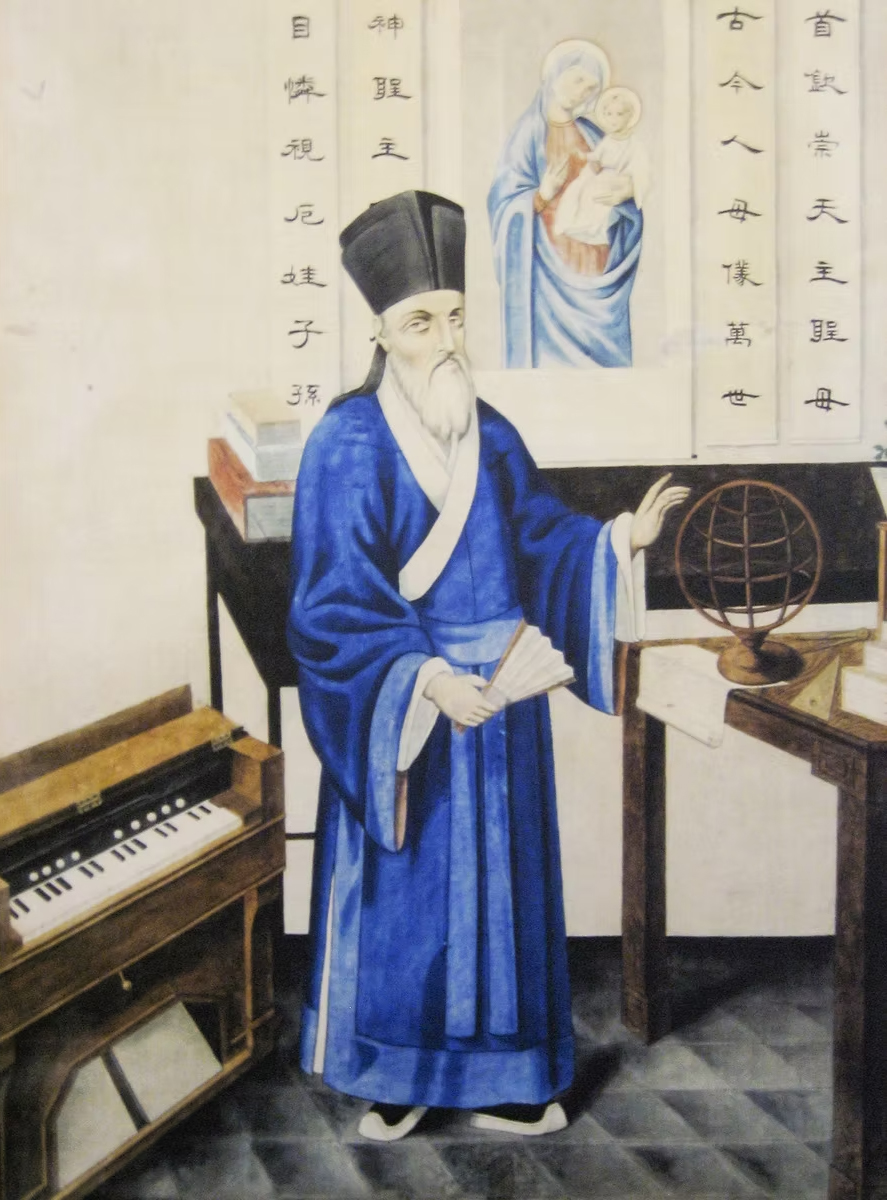
Protait of Matteo Ricci Date:before 1610 Author: unkonwn Copyright: Wikimedia Commons
Jesuit missionaries came to China in the late Ming Dynasty. The Italian Matteo Ricci (1552~1610), in addition to actively preaching, also brought European science at that time. Ricci brought an astrolabe with him when he came to China. He recorded in his diary that he used the astrolabe to observe the stars and measure the height of mountains in southern China.

Portrait of Christopher Clavius Date:circa 1606 Author: drawn by Francesco Villamena, 1566–1624 ; engraved by Jean Leclerc, 1585-1633
Matteo Ricci studied under the Jesuit astronomer Christoph Clavius (1538~1612) in his early years. While in China, he was also influenced by his Astrolabium published in 1593. This book has been used frequently to explain Western astronomy ever since.

Illustrated pages from the block-printed edition of Hungai Tongxian Tushuo Date: 1607 Author: Sabatino de Ursis Source & Copyright: National Library of China
Under the guidance of Matteo Ricci, Li Zhizao, a native of Hangzhou, Zhejiang, wrote Hungai Tongxian Tushuo (Illustrated Introduction of Astrolabe) and printed it in Chuzhou, Zhejiang in the early 34th year of Wanli (1607). This is the first astrolabe book in Chinese. It introduces the making and use of astrolabes, with a large number of illustrations, and also introduces the use of Western compasses. The book was later reprinted many times and included in Siku Quanshu (Complete Library of the Four Treasuries).
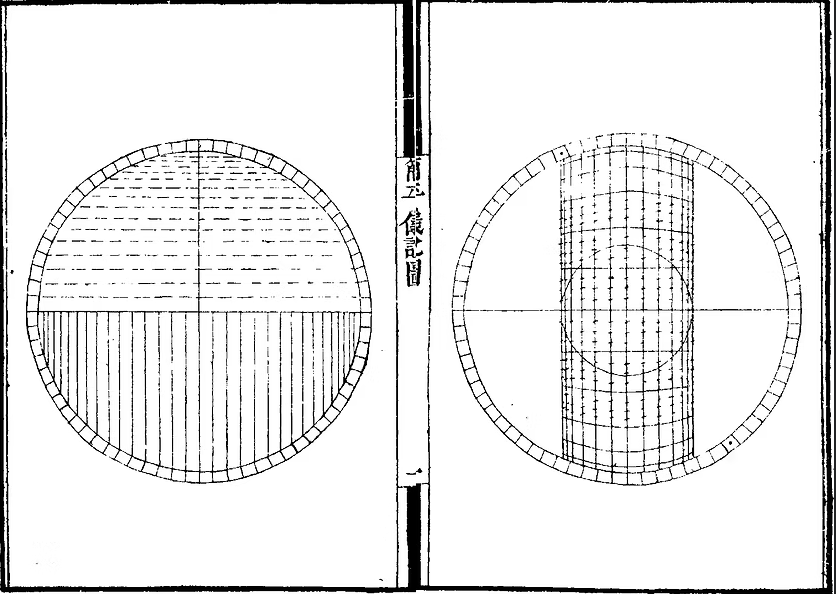
Illustrated pages from the block-printed edition of Jianpingyi Shuo Date: Qing Dynasty Author: Sabatino de Ursis Source: Copyright: Chinese Text Project https://ctext.org/zhs
The book Jianpingyi Shuo (Introduction of Planisphaerium), introducing the instrument planisphaerium similar to the astrolabe, was written by the Italian missionary Sabatino de Ursis (1575~1620), with a preface by Xu Guangqi, and was published in Beijing in early 1611. In the Qing Dynasty China, these two books were often studied together by scholars.