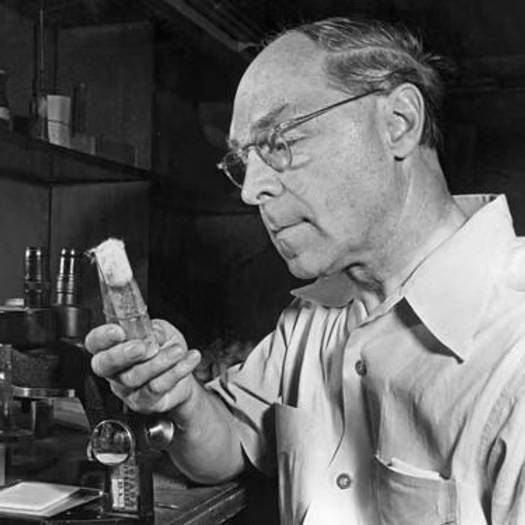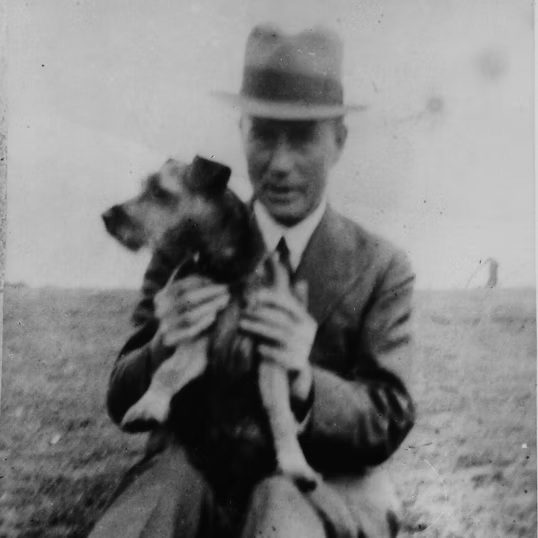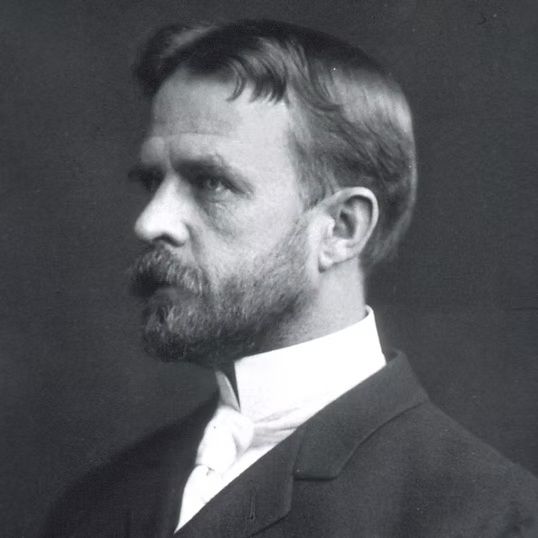
托马斯·摩尔根Thomas H. Morgan
(1866-1945)(1866-1945)



在发表之前不让材料外泄,或者让自己的想法和进展秘而不宣,对我个人来说从来都没有吸引力。可能,我们不可以说这里有特殊的美德,因为果蝇像我们呼吸的空气一样,足够每个人使用。
The method of locking up your stuff until you have published about it, or of keeping secret your ideas and progress have never appealed to me personally. It may be, that we can claim no special virtue here, for Drosophila is like the air we breathe—there is enough for all.
托马斯·摩尔根 1917 年 7 月 25 日写给罗伯特·伍德沃德的信
Thomas Morgan to Robert S. Woodward, July 25, 1917.
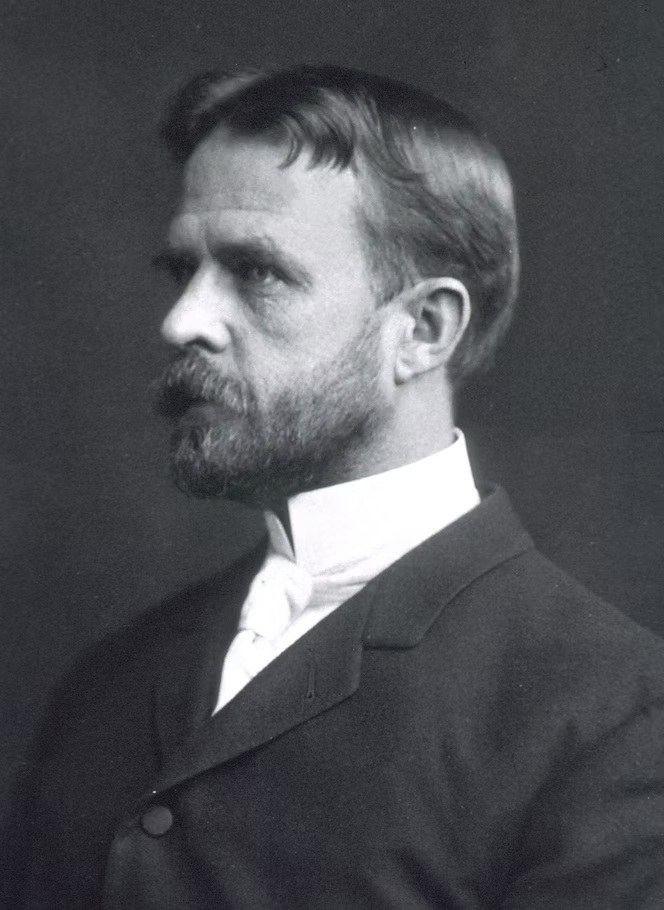
托马斯·摩尔根于1866年9月25日出生于肯塔基州的列克星敦。他年轻时对肯塔基山脉的化石有特殊的兴趣。摩尔根在肯塔基大学获得学士学位,并于1890年在约翰霍普金斯大学获得博士学位。
1904年,摩尔根和他的妻子莉莲·沃恩·摩尔根(1870-1952)搬到哥伦比亚大学,摩根在那里被任命为实验动物学教授。黑腹果蝇于1908年被引入哥伦比亚大学的实验室。在接下来的几年里,他对果蝇进行了研究,使其成为基因研究中最著名的模式生物。摩尔根是第一个将特定性状的遗传与特定染色体明确联系起来的人。
1910年,摩尔根开始招募本科生在“果蝇室”研究果蝇,在那里他们呆了17年。主要成员包括卡尔文·布里奇斯(1889-1938)、阿尔弗雷德·斯图特万特(1891-1970)、奥托·卢兹·莫尔(1886-1967)、西奥多·多布赞斯基(1900-1975)、穆勒(1890-1967)和柯特·斯特恩(1902-1981)。他们表明,基因在染色体上以一系列方式连接,并发展了交换机制和基因图谱的概念。
1928年,摩尔根离开哥伦比亚大学,成为加州理工学院的生物学教授。1933年,他因“关于染色体在遗传中所起作用的发现”而获得诺贝尔生理学或医学奖。
Thomas Morgan was born on 25 September 1866 (the year Mendel published his famous paper) in Lexington, Kentucky. Morgan developed a special interest in fossils in the Kentucky mountains when he was a young man. Morgan received his BS degree from the University of Kentucky and received his PhD at Johns Hopkins University in 1890.
In 1904, Morgan and his wife Lilian Vaughan Morgan (1870-1952) moved to Columbia University, where Morgan was appointed professor of experimental zoology. The fruit fly Drosophila melanogaster was introduced into his lab at Columbia University in 1908. He studied Drosophila melanogaster over the following years, making it the most famous model organism for genetic studies. Morgan was the first person to definitively link the inheritance of a specific trait with a particular chromosome.
In 1910, Morgan started to hire undergraduates to work on Drosophila in the “fly room” where they remained for the next seventeen years. The main members include Calvin Bridges (1889-1938), Alfred Sturtevant (1891-1970), Otto Lous Mohr (1886-1967), Theodosius Dobzhansky (1900-1975), H. J. Muller (1890-1967) and Curt Stern (1902-1981). They showed that genes are linked in a series on chromosomes and developed the mechanism of crossing-over and the concept of genetic mapping.
In 1928 Morgan left Columbia to become professor of biology at the California Institute of Technology. He received the Nobel Prize for Physiology or Medicine in 1933 “for his discoveries concerning the role played by the chromosome in heredity”.
摩尔根被公认为是二十世纪最有影响力的生物学家之一。此外,通过指导中国学生如陈桢(1894-1957)、李汝琦(1895-1991)和谈家桢(1909-2008),摩尔根对中国遗传学也产生了重要影响。
Morgan is widely recognized as one of the most influential biologists of the twentieth century. By guiding Chinese students including Chenzhen (1894-1957), Liruqi (1895-1991) and Tanjiazhen (1909-2008), he also had an important impact on Chinese genetics.
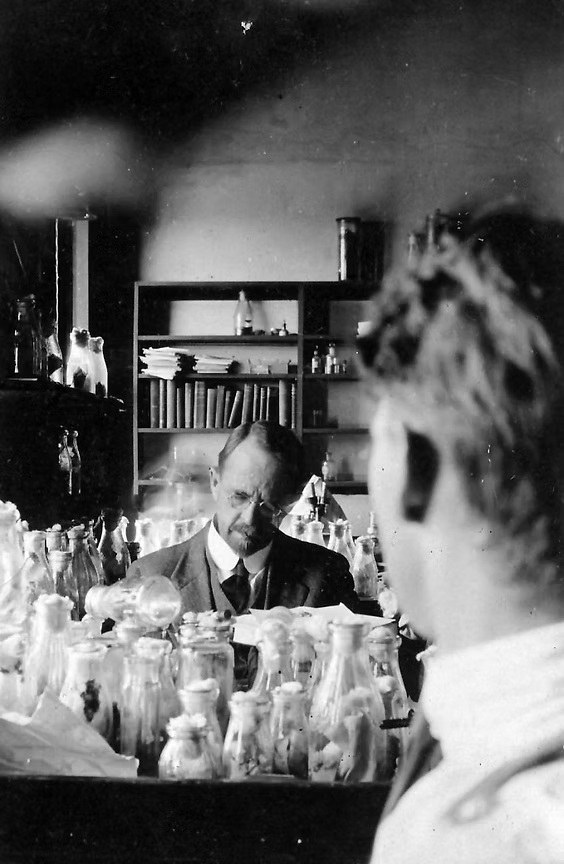
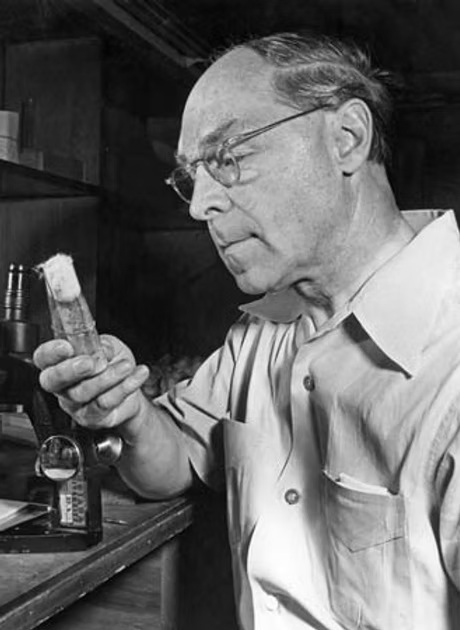
赫尔曼·约瑟夫·穆勒1890年12月21日出生于纽约市。穆勒从1907年到1909年就读于哥伦比亚大学,细胞学家E.B.威尔逊(1856-1939)激发了他对遗传的兴趣。1910年到1915年,穆勒在托马斯·摩根的指导下研究了果蝇的遗传和基因突变。穆勒证实染色体是后代从父母那里继承性状的物理成分。
1920年,穆勒到德克萨斯大学任教,开始用x射线进行果蝇实验。1927年,他证明了x射线可以改变遗传物质的结构。之后,他离开德克萨斯大学前往欧洲从事研究工作,从1934年到1937年,他在苏联莫斯科科学院遗传学研究所任高级遗传学家。1940年,穆勒回到美国。他曾为曼哈顿项目提供咨询,并就与辐射突变效应有关的实验提供建议。
1946年,穆勒因1927年在辐射诱导的基因突变方面的研究获得了诺贝尔生理学和医学奖。
Hermann Joseph Muller was born on 21 December 1890 in New York City, New York. Muller attended Columbia University from 1907 to 1909, where his interest in genetics was fired first by E.B. Wilson (1856-1939), a cytologist. From 1910 to 1915, Muller studied heredity and genetic mutations in the fruit fly (Drosophila) with the guidance of Thomas Morgan. Muller verified earlier theories that chromosomes are the physical components by which offspring inherit traits from their parents.
In 1920, Muller moved to the University of Texas, where he used x-rays in his experiments with fruit flies. He demonstrated that x-rays can mutate the structure of genetic material in 1927.
He then left the University of Texas for research jobs in Europe, and from 1934 to 1937, he was the senior geneticist at the Institute of Genetics of the Academy of Sciences in Moscow, USSR. Muller returned to the United States in 1940. He consulted on the Manhattan Project and provided advice on experiments pertaining to the mutational effects of radiation.
In 1946, Muller received a Nobel Prize in Physiology or Medicine for his 1927 work on radiation-induced genetic mutations.
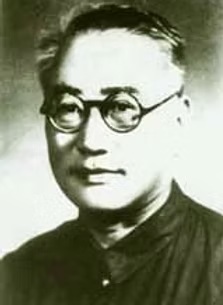
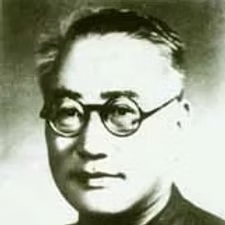
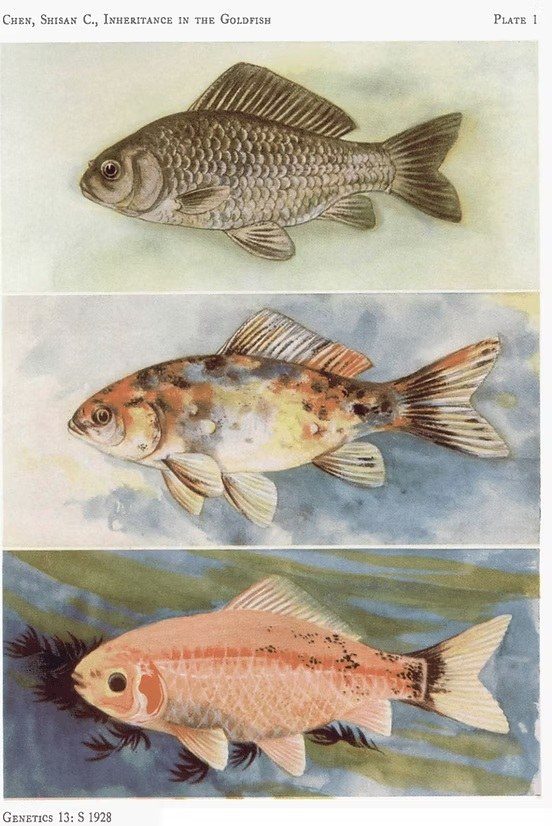
陈桢(1894—1957)出生于江苏邗江县,是我国著名的动物学家、生物学史家,也是我国遗传学家、动物行为学的奠基者和创始人之一。1914年,他考入南京金陵大学,进入该校刚刚设立的农科学习,1919年,陈桢取得了清华学校公费赴美国专修生物学的留学资格,赴美国康奈尔大学攻读研究生,1920年春转到哥伦比亚大学,在细胞学家威尔逊(E.B. Wilson)实验室研修。1921年他获得哥伦比亚大学硕士学位,随后又师从美国遗传学家摩尔根(T.H.Morgan)教授,从事遗传学研究。1928年,陈桢在《Genetics》上发表了《透明和五花,金鱼中第一例孟德尔式遗传》,是国际上第一个以金鱼为对象证明基因不完全显性遗传的工作。
1929年,清华大学罗家伦校长邀请他来清华大学生物系主持工作,他到1952年一直担任清华大学生物系主任。1952年,全国高等学校院系调整,北京大学、燕京大学和清华大学三校的生物学系合并成为北京大学生物系,陈桢改任北京大学生物系教授兼研究室主任。陈桢1948年当选为中央研究院院士,1955年当选为中国科学院首批学部委员。
Chen Zhen (1894-1957) is a famous zoologist and biological historian in China. He is also a geneticist and one of the founders of animal behavior in China. In 1914, he was admitted to Nanjing Jinling University and entered the newly established agricultural department of the University. In 1919, Chen Zhen obtained the qualification of Tsinghua University to study biology in the United States at public expense, went to Cornell University to study as a graduate student, and transferred to Columbia University in the spring of 1920 to study in the laboratory of E.B. Wilson. In 1921, he received a master's degree from Columbia University, and then studied genetics under Professor T.H. Morgan, an American geneticist. In 1928, Chen Zhen published "transparency and five flowers, the first Mendelian inheritance in goldfish" on genetics, which is the first work in the world to prove incomplete dominant inheritance of genes in goldfish.
In 1929, President Luo Jialun of Tsinghua University invited him to preside over the Department of biology of Tsinghua University. He had been the director of the Department of biology of Tsinghua University until 1952. In 1952, the departments of colleges and universities across the country were adjusted. The biology departments of Peking University, Yanjing University and Tsinghua University merged into the Biology Department of Peking University. Chen Zhen was changed to Professor and director of the Research Office of the Biology Department of Peking University. Chen Zhen was elected as an academician of the Central Academy of Sciences in 1948 and the first member of the Faculty of the Chinese Academy of Sciences in 1955.
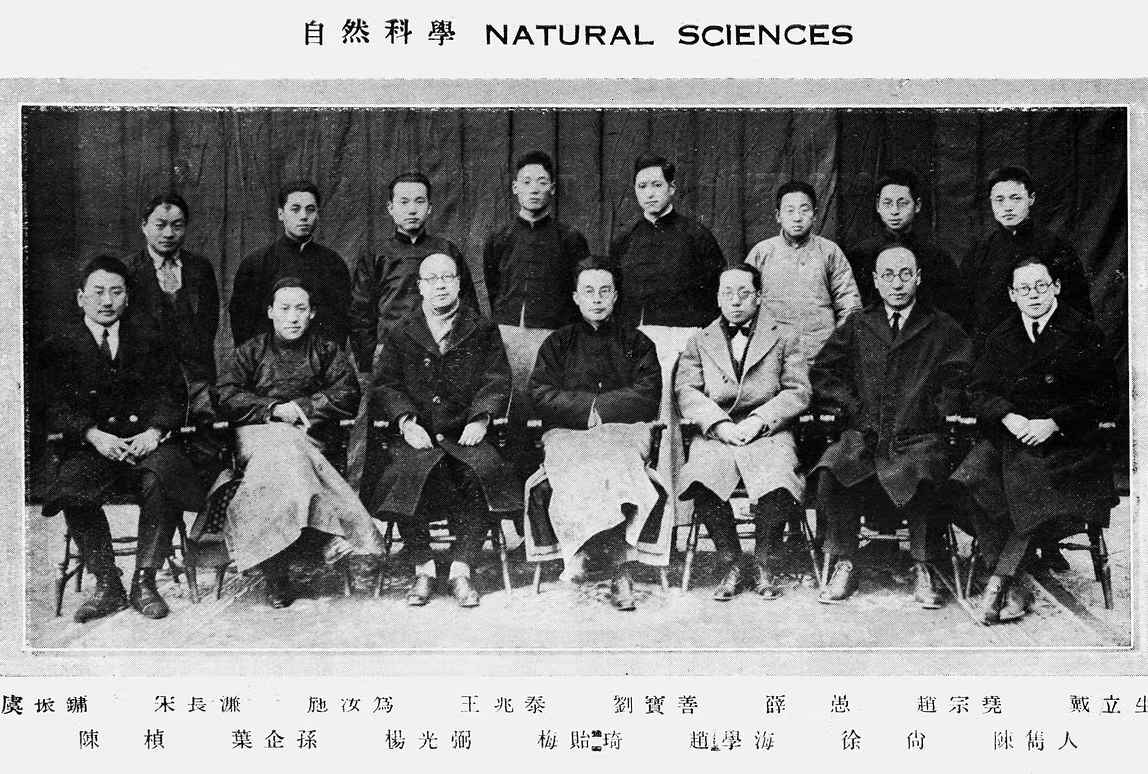
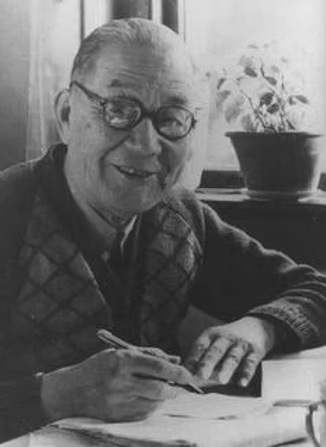
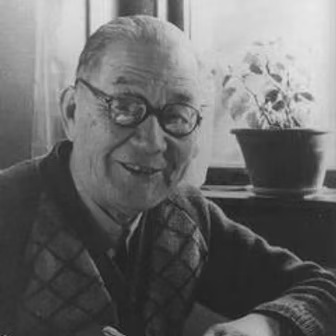
李汝祺1895出生于天津市,1911年考取清华留美预备学校,1919年毕业,1919到1923年在美国普渡大学就读。之后他进入美国哥伦比亚大学动物学系研究院,在摩尔根(T.H.Morgan)及毕瑞吉斯(C.B. Bridges)的指导下进行博士论文工作,1926年以优异的成绩获得博士学位,于1927年在《Genetics》杂志上发表了他的论文《果蝇染色体结构畸变在其发育上的效应》。之后李汝祺回国任教,任上海复旦大学副教授、燕京大学生物系教授、北京大学医学院教授、北京大学动物系主任兼医预科主任、北京大学生物系教授兼遗传教研室主任。
Born in Tianjin in 1895, Li Ruqi was admitted to Tsinghua preparatory school for studying in the United States in 1911, graduated in 1919, and studied at Purdue University in the United States from 1919 to 1923. After that, he entered the Research Institute of the Department of zoology of Columbia University and worked on his doctoral thesis under the guidance of T.H. Morgan and C.B. Bridges. In 1926, he received his doctoral degree with excellent results. In 1927, he published his paper "the effect of structural aberration of Drosophila chromosome on its development" in the Journal of genetics. In Shanghai, he later taught as an associate professor of Fudan University, Professor of the Biology Department of Yanjing University, Professor of Peking University School of Medicine, director of the Department of zoology and director of the pre-Medical Department of Peking University, and Professor of the Department of biology and director of the genetics teaching and research office of Peking University.
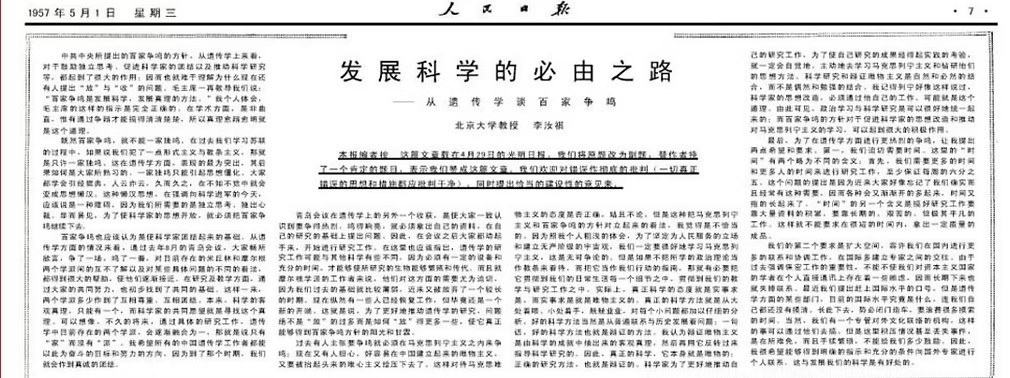
1957年4月29日《光明日报》刊登了北京大学生物系教授李汝祺《从遗传学谈百家争鸣》的文章,毛泽东读到以后,即建议《人民日报》转载,并亲自把文章标题改为《发展科学的必由之路》,以原来的标题作为副标题,还为之写了按语。
On April 29th, 1957, GuangMing Daily published an article by Li Ruqi, "talking about the contention of a hundred schools of thought from genetics". After reading it, Mao Zedong suggested that the People's Daily reprint it, and personally changed the title of the article to "the only way to develop science", with the original title as the subtitle, and also wrote a note for it.
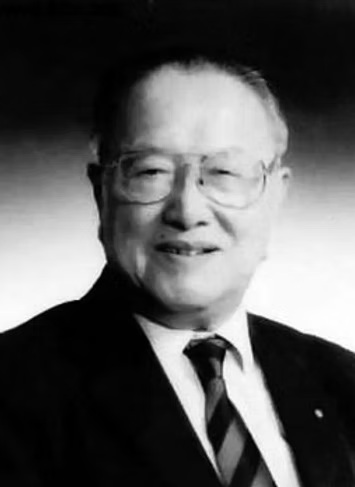
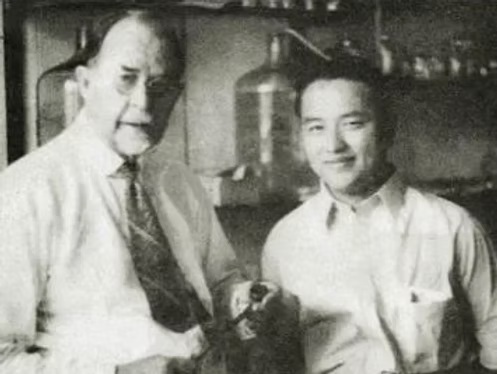
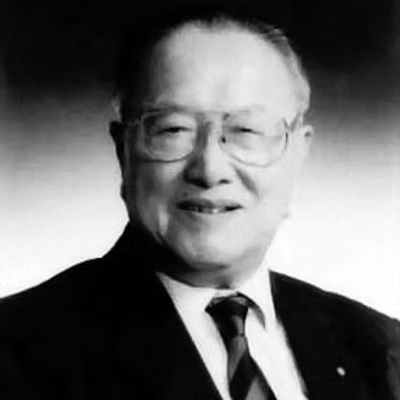
谈家桢1909年9月15日出生于浙江宁波慈溪。1926年,谈家桢保送进入东吴大学,学习生物学。1930年,谈家桢成为燕京大学李汝祺教授的研究生,开展亚洲瓢虫的色斑遗传规律研究。在李汝祺的帮助下,1934年,谈家桢赴美国加州理工学院攻读博士学位,师从现代遗传学奠基人摩尔根,并于1936年博士毕业,同年在《Genetics》上发表《果蝇常染色体的遗传图谱》。
Tan Jiazhen was born in Cixi, Ningbo, Zhejiang Province on September 15, 1909. In 1926, Tan Jiazhen was escorted to Soochow University to study biology. In 1930, Tan Jiazhen became a graduate student of Professor Li Ruqi of Yanjing University to carry out research on the genetic law of color spots of Asian ladybugs. With the help of Li Ruqi, in 1934, Tan Jiazhen went to California Institute of Technology to study for a doctor's degree, studied under Morgan, the founder of modern genetics, and graduated with a doctor's degree in 1936. In the same year, he published the genetic map of Drosophila autosomes on genetics.
Tan Jiazhen returned to China in 1937 to teach in the Biology Department of Zhejiang University. After the Department was adjusted in 1952, he served as the director of the Biology Department of Fudan University. After the reform and opening up, Tan Jiazhen became active on the international academic stage again, promoted international academic exchanges, introduced advanced instruments, and promoted the development of molecular biology in China. In 1983, Tan Jiazhen was awarded the honorary Medal of "outstanding alumni" by the California Institute of Technology, and was elected as a foreign academician of the American Academy of Sciences in 1985.
谈家桢1937年回国任教于浙江大学生物系,1952年院系调整后,他担任复旦大学生物系主任。改革开放之后,谈家桢重新活跃在国际学术舞台,促成国际学术交流,引进先进仪器,推动了我国分子生物学的发展。1983年,谈家桢被加州理工学院授予“杰出校友”荣誉奖章,1985年被选为美国科学院外籍院士。
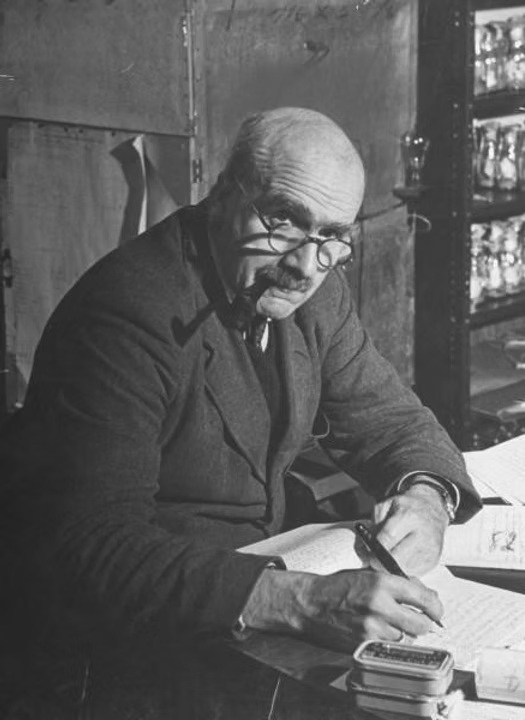
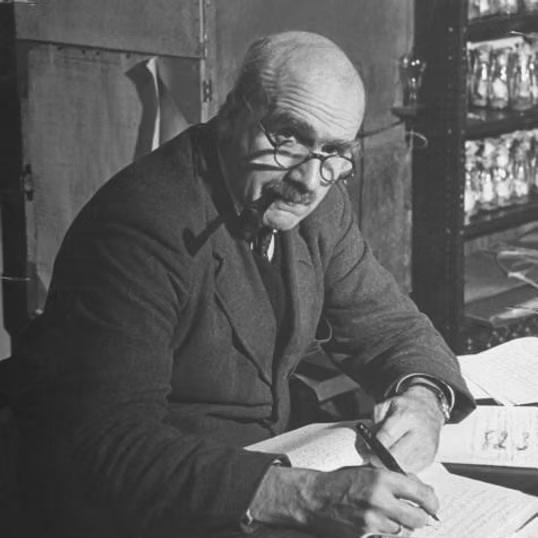
约翰·伯登·桑德森·霍尔丹(1892年11月5日-1964年12月1日),英国遗传学家和进化生物学家。他与罗纳德·费舍尔(1890-1962)和西沃尔·赖特(1889-1988)一起,是群体遗传学的创始人之一。
他是英国著名生理学家、牛津大学教授约翰·斯科特·霍尔丹(1860-1936)的儿子,8岁时作为父亲的助手开始学习科学。霍尔丹在伊顿公学和牛津新学院接受了古典文学的正规教育。第一次世界大战期间,霍尔丹曾在法国和伊拉克服役。战后,霍尔丹在新学院担任研究员,然后搬到剑桥,后来又到伦敦大学学院。
霍尔丹的工作通过解释孟德尔遗传学的数学结果,即“现代进化综合”,将自然选择重新确立为进化的首要机制。霍尔丹1923年的文章《代达罗斯》在预测许多科学进步方面意义非凡。他在题为“未来一万年人类的生物学可能性”的演讲中创造了“克隆”一词。1957年,霍尔丹移居印度,1964年去世。
John Burdon Sanderson Haldane FRS (November 5, 1892 – December 1, 1964), was a British geneticist and evolutionary biologist. He was one of the founders of population genetics, along with Ronald Fisher (1890-1962) and Sewall Wright (1889-1988).
He was son of the noted British physiologist John Scott Haldane (1860-1936) and began studying science as assistant to his father at the age of eight. Haldane received formal education in the classics at Eton College and at New College, Oxford. During the First World War, Haldane served in France and Iraq. After the war, Haldane worked as a fellow of New College, then moved to Cambridge and later University College, London.
Haldane’s work reestablished natural selection as the premier mechanism of evolution by explaining it in terms of the mathematical consequences of Mendelian genetics, known as the "modern evolutionary synthesis". Haldane’s essay in 1923, Daedalus, was remarkable in predicting many scientific advances. He coined the term "clone" in a speech entitled, "Biological Possibilities for the Human Species of the Next Ten-Thousand Years".
In 1957 Haldane moved to India and died in 1964.
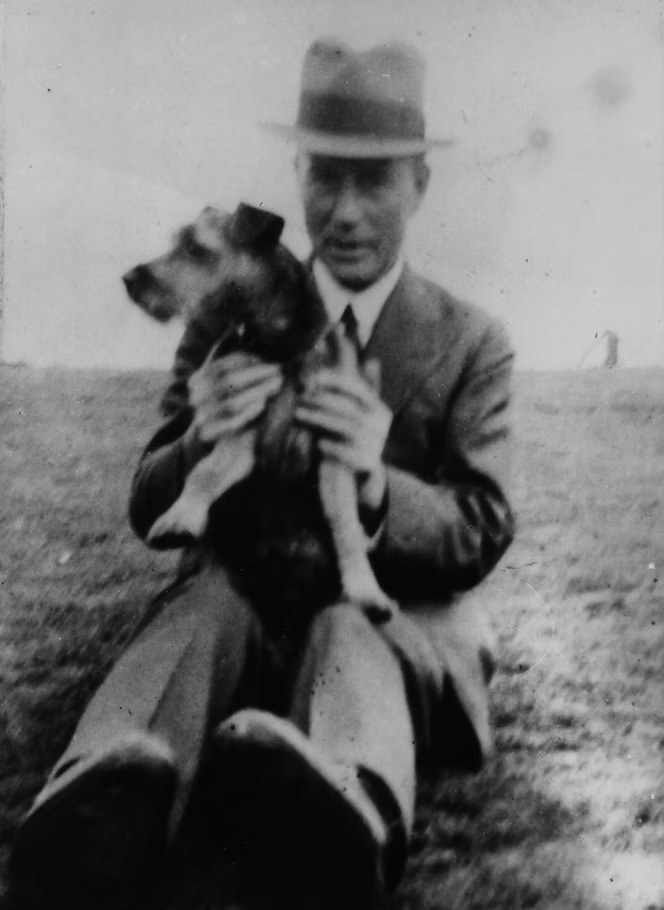
弗雷德里克·格里菲斯(1877年—1941年)是英国细菌学家,他的研究重点是细菌性肺炎的流行病学和病理学。格里菲斯早年在利物浦大学学习医学,后来在英国卫生部病理学实验室工作,在同行间以他细致彻底和有条理的研究为人称道。
在英国政府的支持下,格里菲斯收到来自全英国各地病人的肺炎球菌样本,积累了可观的数量,并对每个肺炎球菌样本进行分类,以寻找肺炎的流行病学模式;他还在小鼠身上进行实验以增进对肺炎的病理学理解。在1920年代,格里菲斯主持进行了许多关键性的实验。1928年1月,他报道了现在被称为格里菲斯实验(Griffith’s Experiment)的内容,这是第一个被广泛接受的细菌转化(transformation)的证明。
Frederick Griffith (1877-1941) was a British bacteriologist whose focus was the epidemiology and pathology of bacterial pneumonia. Griffith studied medicine at the University of Liverpool and later worked at the Pathological Laboratory of the Ministry of Health. He developed a reputation for his thorough and methodical research.
With support from the UK government, Griffith was sent pneumococci samples taken from patients throughout the country, amassed a large number, and would classify each pneumococci sample to search patterns of pneumonia epidemiology; he also experimented on mice for improved understanding of its pathology. The pivotal experiments — actually very many experiments — were performed during the 1920s. In January 1928 he reported what is now known as Griffith's Experiment, the first widely accepted demonstration of bacterial transformation.
格里菲斯实验由弗雷德里克·格里菲斯在1928年报道,是第一个表明细菌能通过被称为转化(transformation)的过程来传递遗传信息的实验。
在一战后的西班牙流感大流行之后,肺炎是一种严重的致死性疾病,格里菲斯致力于研究制造疫苗的可能性。他使用了两种感染小鼠的肺炎链球菌(Streptococcus pneumoniae)菌株:一种是具有毒力的S型菌株(菌落光滑型),另一种是不具有毒力的R型菌株(菌落粗糙型)。S型菌株可以合成多糖荚膜以保护自身不受宿主免疫系统的攻击,并导致宿主死亡;R型菌株没有荚膜,会被宿主的免疫系统消灭。
在格里菲斯实验中,S型菌株被加热杀死后,其残余物被加入R型菌株的活细菌中;虽然单独的R型细菌和加热杀死后的S型细菌都不对小鼠有毒力,但二者混合后却会引起小鼠死亡;从死亡小鼠的血液中还能够分离出活的R型和S型细菌。
格里菲斯得出结论认为,R型细菌是被“转化”为了致死的S型细菌,这是通过被加热杀死后的S型细菌中的某种潜在的未知因子实现的,后来在艾弗里(Avery)实验室被称为“转化因子”。
这一转化因子的确切本质(DNA)要在几年后被艾弗里、麦克劳德、麦卡蒂等人进行的肺炎链球菌离体转化实验(Avery-McLeod-McCarty experiment,1944年发表)和赫尔希、蔡斯进行的T2噬菌体侵染大肠杆菌实验(Hershey-Chase experiment,1952年)所证实。
Griffith's experiment, reported in 1928 by Frederick Griffith, was the first experiment suggesting that bacteria are capable of transferring genetic information through a process known as transformation.
Pneumonia was a serious cause of death in the wake of the post-WWI Spanish influenza pandemic, and Griffith was studying the possibility of creating a vaccine. Griffith used two strains of pneumococcus (Streptococcus pneumoniae) bacteria which infect mice – a type III-S (smooth) which was virulent, and a type II-R (rough) strain which was nonvirulent. The III-S strain synthesized a polysaccharide capsule that protected itself from the host's immune system, resulting in the death of the host, while the II-R strain did not have that protective capsule and was defeated by the host's immune system.
In this experiment, bacteria from the III-S strain were killed by heat, and their remains were added to II-R strain bacteria. While neither alone harmed the mice, the combination was able to kill its host. Griffith was also able to isolate both live II-R and live III-S strains of pneumococcus from the blood of these dead mice. Griffith concluded that the type II-R had been "transformed" into the lethal III-S strain by a "transforming principle" that was somehow part of the dead III-S strain bacteria.
He showed that Streptococcus pneumoniae, implicated in many cases of lobar pneumonia, could transform from one avirulent strain into a different, virulent strain. The observation was attributed to an unidentified underlaying principle, later known in the Avery laboratory as the "transforming principle" and identified as DNA.
The exact nature of the transforming principle (DNA) was later verified in the experiments done by Avery, McLeod and McCarty (published 1944) and by Hershey and Chase (1952).
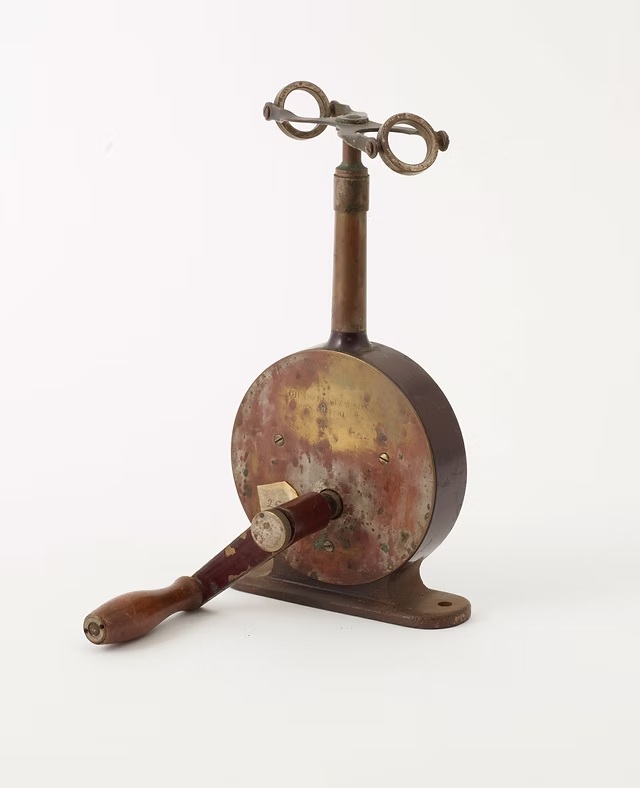
带有可拆卸木柄的黄铜仪器,可容纳两个离心管,用于从少量液体中快速沉淀悬浮固体。
由 Charles Lentz & Sons 公司和 Bausch + Lomb 公司制造。
Brass instrument with removable wooden handle. Holds two centrifuge tubes. Used for rapid settling of suspended solids from small quantities of liquid in analytical or clinical procedures.
Manufactured by Charles Lentz & Sons and Bausch + Lomb.
Science History Institute. Hand Operated Centrifuge. Photograph, 2021. Science History Institute. Philadelphia.
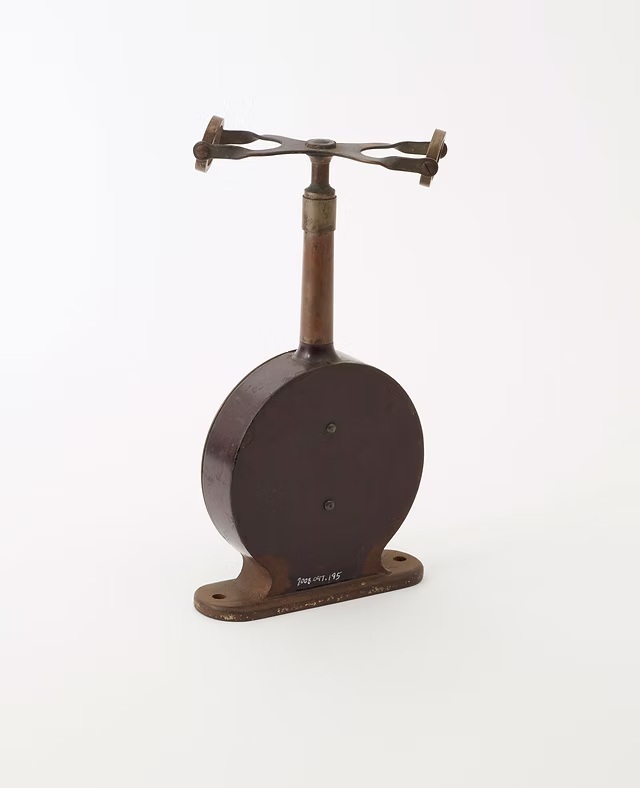
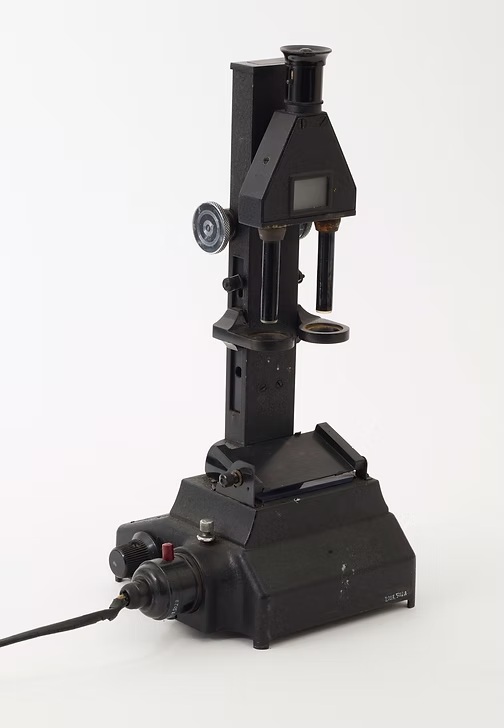
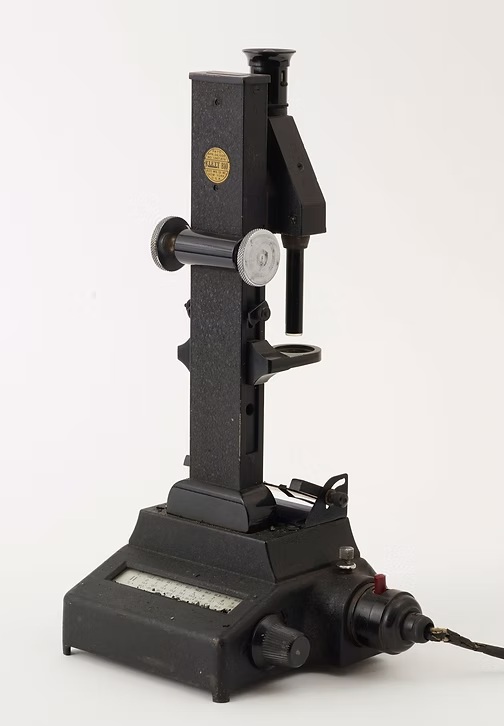
克莱特生物色度计用于测量特定溶液对特定波长的光的吸光度。色度计通常用于通过应用比尔-朗伯定律(Beer-Lambert law)来确定给定溶液中已知溶质的浓度,比尔-朗伯定律指出溶质的浓度与吸光度成正比。
该色度计专为临床实验室工作而设计。比如,它们可用于确定血液中血红蛋白或其他物质的浓度。这款色度计包括由玻璃制成的标准色盘,用于代替标准溶液进行颜色比较。立柱上的两个不锈钢旋钮控制样品架的高度,空心底座包括一个灯泡和一张血红蛋白结果表。
Klett Bio Colorimeter, a device used in colorimetry to measure the absorbance of particular wavelengths of light by a specific solution. Colorimeters are commonly used to determine the concentration of a known solute in a given solution by the application of the Beer-Lambert law, which states that the concentration of a solute is proportional to the absorbance.
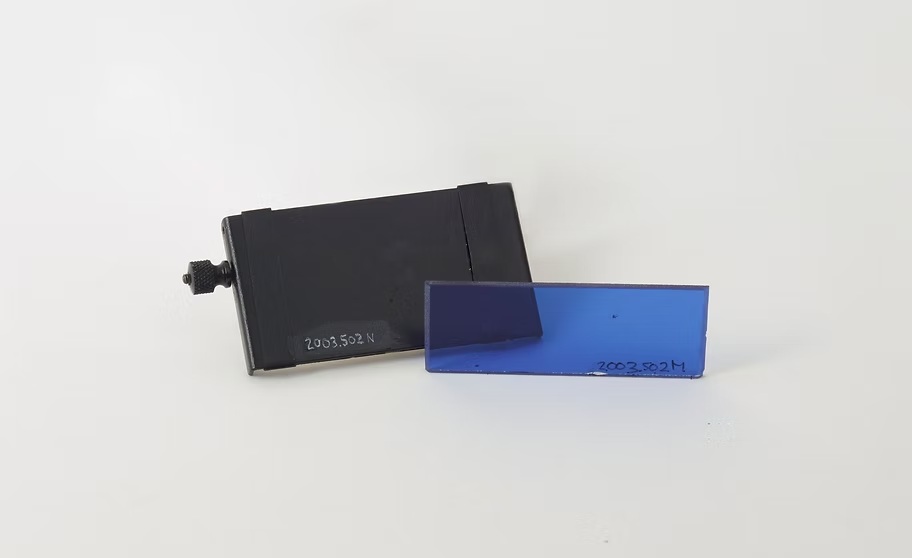
Klett Bio Colorimeters were specifically designed for clinical laboratory work. For example, they can be used to determine the concentration of hemoglobin, or other substances, in blood. This Klett colorimeter includes standard color disks made of glass, which can be used in place of standard solutions in color comparisons. The color disks are inserted into glass "plungers," similar to the glass sample cups, and viewed alongside the samples. The colorimeter's black metal base is attached to an upright made of hollow bronze and finished with black enamel which supports the microscope reader. Two stainless steel knobs on the upright control the height of the sample stand. The base supports a sliding metal and glass daylight filter and a blue glass color filter. The hollow base contains a light bulb and a hemoglobin results table, printed on linen, is built into the bottom front of the base and can be scrolled through with a black plastic knob.
Science History Institute. Klett Bio Colorimeter. Photograph, 2021. Science History Institute. Philadelphia.